
What is a Character Sheet?
A character sheet is a series of papers that records your character’s abilities, class, name, backstory, spells, equipment, and basically anything else you can think of. It is all found on the character sheet. Without this, you cannot play DnD. They can be printed out from websites like DND Beyond; some people make custom character sheets and share those online as well. For further details, take a look at the Other Resources page.

Where do I start with my Character Sheet?
Start by picking your class, which is the thing that determines what abilities you have. The base game includes a variety of options ranging from the more magical Wizards, Sorcerers, and Warlocks to physical fighters like Rogues, Paladins, and Monks. That doesn’t mean that your character is completely locked into one option, however. All classes feature subclasses (for example, a Wizard could subclass into a Necromancer or a Ranger could subclass into Beastmaster) that let you pick one area to specialize in and get unique bonuses.
Next, decide what race (referred to as species in newer versions) your character is. Different species give different bonuses as well as special traits like being able to see in the dark, being able to fly, and being able to breathe fire.
After that, choose your background. Maybe your character was a wizard raised in a remote area, so they would be a hermit. Or maybe they were a rogue who scammed people, so they would be a charlatan. These give your characters certain items and abilities.
How to create your Stat Blocks
Your stat block is the main thing that influences your rolls. Your stat block details a wide range of things, including ability scores, saving throws, skills, and feats. The first thing to determine are your ability scores, the big blocks on the left side of the sheet. The way to find these out can be done either by taking a prerecorded number for each of the stats or by rolling a six-sided die four times and subtracting the lowest roll.

You can add your rolls to your stat block once you’ve finished. Depending on what class you pick, you should focus your higher scores into the class’s strengths. More magic-focused characters should put their big numbers into Intelligence and Wisdom, and physical fighters Strength and Constitution. That isn’t to say that you should completely ignore the other traits however.
The oval below the Ability Score is where your Ability Modifier goes. Ability Modifiers are what you add to your roll when performing ability checks. For instance, if you roll a 10 for a Strength ability check, but you had an Ability Modifier of +4, your final result would be 14. In order to find out what your Ability Modifiers are, you would subtract ten from your Ability Score and divide the result by 2. For example, an Ability Score of 12 minus 10, divided by 2, would give you an Ability Modifier of +1.
How to generate Skill Scores
Skill Scores are specific ability checks. For example, if you were trying to see if a berry was poisonous or not you would make a nature check. In order to find out your Skill Score, you would first reference your Class and Background to see what you’re proficient in. Like your Saving Throws, you would bubble in the circle if you were.
For the Skill Scores you’re proficient in, look at the abilities they fall under.
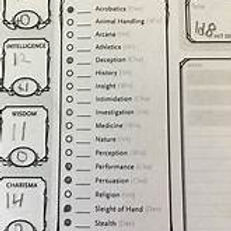
Then add your Ability Modifier to your Proficiency Bonus. For example, if you had a +3 in Wisdom and a +2 as your Proficiency Modifier, then your Medicine score would be +5.
For Skill Scores you aren’t proficient in, just the Ability Modifiers will do.
How do I find my HP, Armor Class, Initiative, Speed, and Hit Dice?
Your HP, or Hit Points, are determined by your class. More physical classes usually have higher HP due to the fact that they roll D10s or D12s to see what they get. More magical classes use dice like D6s or D8s. As you level up, you can either take a set HP raise from the Player’s Handbook or you can roll a dice.
Your Armor Class (AC) is determined by what class you are and what armor you pick out. Light armor gives you a low AC like 11 while heavier armor grants you a high AC like 16. In order for an enemy to hit you, they have to succeed on an attack roll. If your AC is higher than their attack roll (13<16), then they do no damage to you.
Initiative determines the turn order that everyone takes their actions in at the start of a combat encounter. It changes with every fight, so writing initiative isn’t permanent, just a way to keep track of what’s going on.
Your speed is determined by your race.
Hit Dice are rolls you get between short rests to heal up some of your hit points. Every class has a different type of hit dice, so check yours to see what it is.
What's a Death Save?
Once your character’s HP goes to zero, you have to start rolling Death Saves. Roll a D20. If your result is 10 or above, that’s a success. If your number is 9 or lower, then that’s a failure. If you roll a 20, then your character stabilizes (is revived at 1 hit point) immediately. If you roll a 1, it counts as two failures. Once you reach either three successes or three failures, you can’t roll anymore.
There are ways to help a teammate if they are rolling Death Saves. Healing spells will bring them back, as well as healer’s kits (a piece of equipment certain classes start with, but can be used by all). If your campaign has agreed to not use permanent death, then this could be disqualified.
What about the box next to that?
That box is more so for roleplaying than statistics. Fill it out with any close relationships your character might have, your character’s personality, strengths, and weaknesses.
What do I put in Other Proficiencies and Languages?
Certain species and backgrounds give your character the ability to speak multiple languages. Other proficiencies are items that your character can use without having to roll for, like using certain types of armor, types of weapons, and types of tools.
What about Equipment?
Everyone starts with certain equipment. Check your class and background in the Player's Handbook to see what they are. You also start with a set amount of money based on your background as well. Items that you purchase, are given, steal, or find also go in this column.
What about Attacks and Spellcasting?
This is where you put the weapons and offensive spells you have. Write down their damages, what they do, and any special bonus you might get.
What about Features and Traits?
This is a combined record of all of your abilities, from those granted by your species, to your class and your background.